

September’s Hidden Threat to Your Heat Rejection System
The September early fall transition brings welcome relief from the blistering summer sun, but it also introduces a severe hazard to your outdoor HVAC equipment. Understanding exactly how cottonwood debris physically restricts airflow through condenser coils is critical before the heating season begins. When the lingering late summer heat meets the heavy shedding of early fall yard debris, your air conditioner faces a unique and compounding thermodynamic threat. Cottonwood fluff, dry grass clippings, and drifting leaves do not merely make your outdoor unit look untidy; they actively choke the system’s ability to “breathe.” As this debris accumulates, homeowners face a critical decision point: is quickly brushing off the visible white fluff enough to keep the system running, or is a professional deep-cleaning required to restore the necessary airflow?
For comprehensive AC maintenance and to schedule your next AC tune-up, rely on local experts to protect your system’s efficiency.
The Thermodynamics of Heat Rejection: How Condenser Coils Breathe
To understand why debris is so destructive, you first have to understand the baseline physics of how an air conditioner cools a home. An air conditioning system does not magically generate cold air; instead, it operates as a heat transfer machine. It absorbs thermal energy from inside your living space and pumps it outside. The outdoor unit, known as the condenser, serves as the heat rejection center for this entire operation. Inside this metal cabinet, a large fan spins rapidly to pull massive volumes of ambient outdoor air through the sides of the unit and exhaust it out the top.
As this air passes through the unit, it flows over the condenser coils—a network of copper or aluminum tubing filled with high-pressure, superheated refrigerant gas. For the system to function, this incredibly hot refrigerant must release its stored heat into the cooler outdoor air. When the heat successfully dissipates, the refrigerant undergoes a phase change, transforming from a high-pressure gas into a subcooled liquid before traveling back indoors to absorb more heat. This delicate phase change relies entirely on the rapid, uninterrupted dissipation of heat. Any reduction in airflow immediately degrades the thermodynamic efficiency of the entire system, forcing it to run longer and harder to achieve the same cooling result.
The Role of Aluminum Fins in Heat Dissipation
The copper or aluminum tubes holding the refrigerant are surrounded by thousands of paper-thin aluminum fins. These fins serve a singular, vital purpose: they exponentially increase the surface area available for heat transfer. By spreading the heat out across a vast metallic surface, the fins allow the air pulled by the condenser fan to carry the thermal energy away quickly. However, their highly engineered design is exactly what makes them vulnerable. Because these fins are spaced mere millimeters apart to maximize surface area, the micro-gaps between them are easily blocked by environmental particulate, turning a highly efficient heat exchanger into a trapped, insulated box.
The ‘Sweater Effect’: How Cottonwood Fluff Insulates the Coils
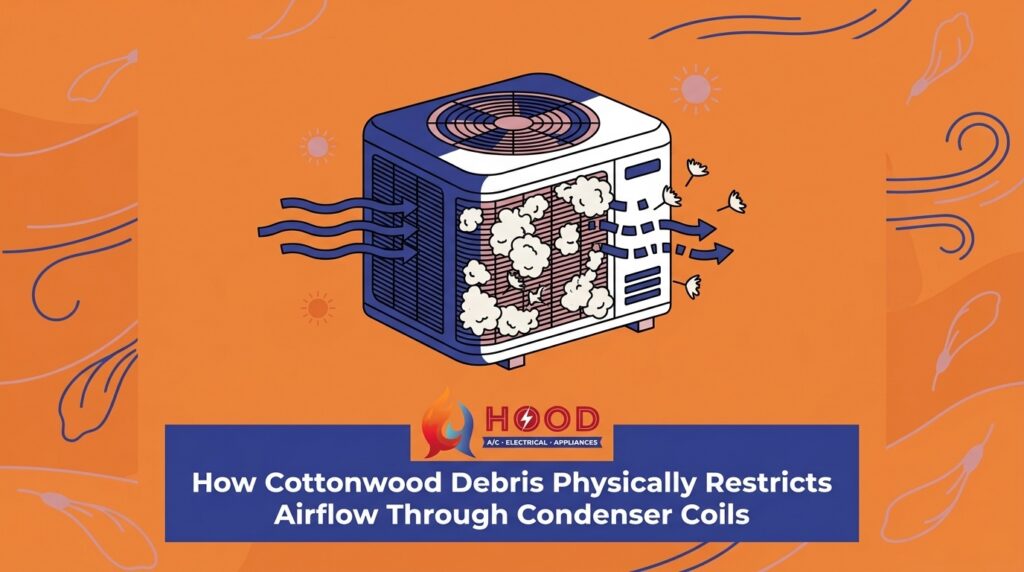
The very mechanism that makes your outdoor unit work—the powerful suction of the condenser fan—is also what draws environmental hazards directly into the equipment. Cottonwood seeds are biologically designed to catch the wind, featuring microscopic fibers that tangle easily. When the condenser fan turns on, it acts like a giant outdoor vacuum cleaner, pulling these lightweight seeds, along with dust, pollen, and grass clippings, straight into the micro-gaps of the aluminum fins.
The resulting blockage creates what HVAC professionals call the “sweater effect.”
Instead of passing through the fins, the debris mats together on the surface and deep within the crevices. This creates a dense, felt-like layer of thermal insulation right where the system desperately needs heat to escape. What looks like a light, harmless layer of white fluff on the outside of the cabinet is actually a restrictive barrier fundamentally altering the coil’s ability to reject heat. Furthermore, moisture from morning dew or early fall rain can cement this biological debris into a solid, impenetrable material that clings stubbornly to the metal.
This phenomenon is especially dangerous in local climates. With Corsicana, TX experiencing intense late summer heat that often drags deep into the autumn months, coils are under maximum load exactly when late-season debris is thickest. The system is fighting to reject high amounts of indoor heat while wearing an insulating blanket of yard waste. Understanding this threat is a key part of covering your outdoor AC unit in Texas during the fall, as managing debris accumulation is essential for long-term system health.
Spiking Head Pressures: The Chain Reaction of Restricted Airflow
When the sweater effect takes hold, the consequences go far beyond a slight drop in cooling performance. The restriction triggers a dangerous mechanical and thermodynamic chain reaction. Because the heat trapped in the refrigerant cannot escape through the insulated coils, the refrigerant temperature remains artificially high. In a sealed refrigeration circuit, temperature and pressure are directly linked. As the temperature fails to drop, the system’s head pressure—the pressure of the refrigerant leaving the compressor—spikes dramatically.
This high head pressure forces the compressor, the “heart” of your HVAC system, to work against massive physical resistance. To push the refrigerant through the restricted system, the compressor must draw significantly higher electrical amperage. According to Department of Energy (DOE) data, dirty condenser coils can increase a compressor’s energy consumption by up to 30%. You are paying significantly more on your utility bills simply to force your equipment to damage itself.
The Path to Thermal Overload
If the airflow restriction is not resolved, the compressor faces an inevitable path toward thermal overload. The continuous strain of operating against high head pressure generates immense internal heat.
- Safety switch trips: Modern compressors are equipped with internal thermal overload switches. When the unit gets dangerously hot, this switch trips, shutting the system down to prevent a catastrophic meltdown. This often results in short-cycling, where the AC turns on and off rapidly.
- Degrading internal windings: Repeated thermal stress bakes the protective insulation off the compressor’s internal electrical windings.
- Premature failure: Once those windings short out, the compressor is dead, often necessitating a complete system replacement rather than a simple repair.

Why Superficial Brushing Fails to Clear Embedded Debris
When homeowners notice their outdoor unit looking like it sprouted white fur, the immediate temptation is to grab a broom or a stiff brush and wipe the visible fluff off the exterior grilles. While this might make the unit look better from the patio, it entirely fails to resolve the underlying thermodynamic restriction. In fact, superficial brushing often does more harm than good.
Because the aluminum fins are spaced so closely together, running a brush across the surface frequently pushes the microscopic fibers, dust, and pollen deeper into the coil matrix. You may remove the outer layer of the “sweater,” but you are simultaneously packing the remaining debris tightly into the center of the fins where it becomes even harder to extract. The most severe airflow restriction happens deep inside the unit, far beyond the reach of a surface-level wipe down.
| Action | Depth of Reach | Risk to Equipment | Thermodynamic Result |
|---|---|---|---|
| Surface Brushing | Exterior cabinet and outer fin edge only | High (pushes debris deeper, risks bending fins) | Fails to restore airflow; high head pressure remains. |
| Garden Hose Spray (Outside-In) | Outer 10% of the coil matrix | High (packs wet dirt into the center of the coils) | Creates a mud barrier; worsens the insulation effect. |
| Professional Deep Cleaning | Entire depth of the coil matrix (Inside-Out) | Low (uses specialized tools and safe pressures) | Fully restores heat rejection; normalizes head pressure. |
Leaving this embedded debris in place during the September early fall transition forces your system to struggle through final heatwaves and prepares it poorly for the off-season. A system that cannot breathe is a system that is actively degrading its most expensive components.
The Risks of DIY Chemical Cleaners and Disassembly
Realizing that brushing isn’t enough, some homeowners turn to the internet for DIY deep-cleaning solutions, which often leads to disastrous results. It is vital to understand the severe risks associated with amateur coil maintenance.
- Corrosive Chemical Cleaners: Store-bought, heavy-duty chemical coil cleaners are often highly acidic or highly alkaline. If these chemicals are not properly diluted, applied, and thoroughly neutralized and rinsed, they will rapidly corrode the delicate aluminum fins. Over time, the fins will literally dissolve, permanently destroying the unit’s ability to reject heat.
- High-Pressure Washing: Using a pressure washer on an air conditioner is one of the fastest ways to destroy it. The sheer force of the water will instantly bend and flatten the paper-thin aluminum fins against themselves. Once flattened, no air can pass through them at all, replicating the exact “sweater effect” you were trying to fix, but with metal instead of cottonwood.
- High-Voltage Exposure: Properly cleaning a coil requires removing the outer casing and often the top fan assembly to wash the unit from the inside out. Strict safety protocols must be followed. Opening the cabinet exposes you to high-voltage electrical components, including the dual run capacitor, which can hold a lethal charge even after the power is disconnected at the breaker.
Protecting the compressor and safely restoring the unit requires specialized tools, chemical knowledge, and professional training. It is never worth risking your safety or your equipment for a DIY attempt.
Professional Coil Restoration for the Early Fall Transition
Professional, thorough AC maintenance goes beyond basic checks to ensure maximum airflow and protect the outdoor unit’s compressor from premature failure. When a licensed technician arrives to address a heavily fouled condenser, they perform a mechanical and thermodynamic restoration, not just a cosmetic cleaning.
First, the technician safely isolates the high-voltage power and carefully opens the unit. By removing the top fan assembly, they gain access to the interior of the coil matrix. This allows them to clean the coils from the inside out, using a low-pressure water flow to push the embedded debris back out the way it came in, rather than packing it deeper. They utilize specialized, non-corrosive foaming coil cleaners that safely lift the biological matter and dirt off the aluminum without causing chemical etching.
If any fins have been bent by hail, flying debris, or previous DIY brushing attempts, the technician uses a specialized tool called a fin comb to painstakingly straighten the metal, restoring the optimal geometric spacing required for maximum airflow. This comprehensive deep cleaning completely resets the system’s thermodynamic baseline. The insulating blanket is removed, the heat can escape freely, and the head pressure drops back to safe, manufacturer-specified levels.
We saw exactly how critical this professional intervention is for one local homeowner this past spring. Their AC unit completely stopped functioning after struggling with restricted airflow and overheating. Because a licensed technician was dispatched promptly to diagnose the thermal overload and handle the warranty claim directly, the unit was repaired fully under warranty without the homeowner having to navigate the complex manufacturer claims process alone. Framing this deep cleaning as an essential part of a comprehensive HVAC maintenance plan ensures your system is safe, efficient, and protected before the heavy heating season begins.
Protect Your Compressor Before the Texas Heat Fades
Cottonwood fluff, grass clippings, and drifting fall leaves are serious thermodynamic hazards, not just minor yard nuisances. When allowed to mat against your condenser coils, they create an insulating barrier that physically restricts airflow, traps heat, and forces your compressor to operate at dangerously high pressures. Ignoring the “sweater effect” or attempting to resolve it with superficial surface brushing leaves the deepest, most restrictive debris completely intact.
Clearing this embedded debris is a critical, non-negotiable step for protecting your compressor’s lifespan. As the seasons shift in Corsicana, TX, do not let your HVAC equipment limp into the autumn months suffocating under a blanket of yard waste. Rely on local experts to safely open the unit, meticulously clean the fins from the inside out, and restore your system’s airflow and efficiency. For complete peace of mind and expert residential HVAC services, ensure your early fall home preparations include professional coil restoration.