

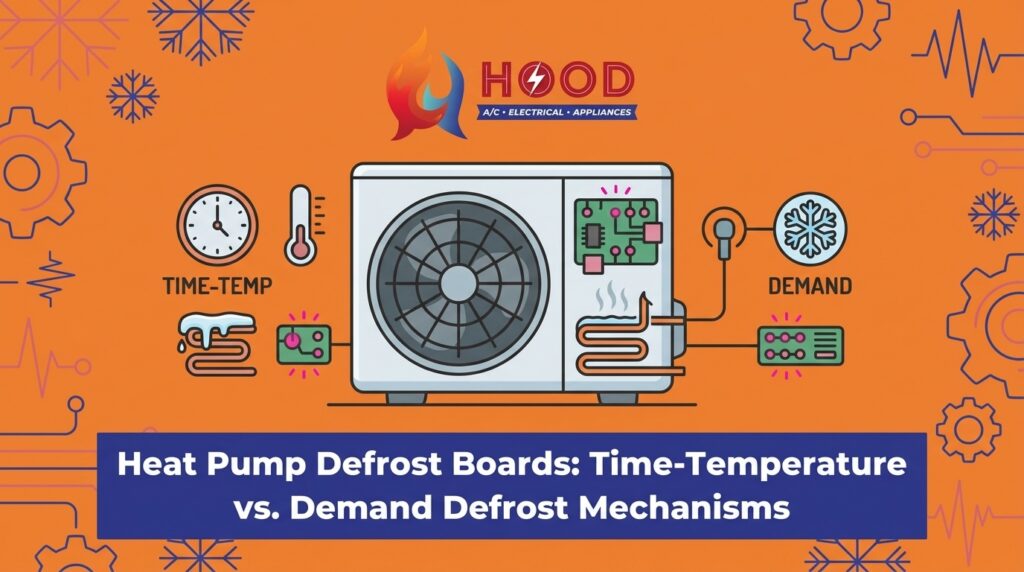
Why Is Your Heat Pump Defrosting When There’s No Ice?
Why does your system suddenly shift into a loud, roaring cycle on a freezing afternoon when there isn’t a speck of frost on the outdoor coil? When exploring heat pump defrost boards: time-temperature vs demand defrost mechanisms, the answer to this frustrating behavior usually comes down to how your equipment measures the cold. At Hood Service Company, our team regularly fields calls from homeowners in Corsicana, Texas, who are confused after hearing their older heat pump shift into a defrost cycle on a bone-dry winter day. The outdoor fan stops spinning, the compressor changes its pitch, and the system temporarily starts blowing cooler air before the backup heat kicks in—all while the outdoor unit is completely free of ice.
This unnecessary cycling is a concrete problem caused by older heat pumps relying on rigid timers rather than actual frost accumulation. Every time your system forces one of these “phantom” defrost cycles, it wastes significant energy and puts unnecessary wear and tear on critical components. Understanding exactly how these control boards operate is a crucial decision point for homeowners trying to determine if an aging system’s inefficiency warrants a repair or a complete upgrade. If you are dealing with a system that seems to run constantly without keeping your home warm, establishing a baseline with our professional heat pump services is the first step toward restoring your winter comfort.
The Mechanics of a Heat Pump Defrost Cycle
To understand why control boards matter, you first have to understand why a heat pump needs to defrost at all. During the winter, your heat pump extracts ambient heat from the outdoor air and transfers it inside. As it pulls this heat out of the air, the refrigerant inside the outdoor coil drops to a temperature well below freezing. Any moisture in the surrounding air condenses on those freezing copper coils, turning into frost. If left unchecked, this frost builds into a thick layer of solid ice, acting as an insulator that blocks airflow and prevents the system from absorbing any more heat. To survive the winter, the system must periodically melt this ice.
In our team’s experience providing heat pump repair since 2015, we have diagnosed thousands of defrost cycles across Corsicana. We immediately recognize the distinct sound and performance drops of a failing reversing valve, which is the mechanical heart of this process. When a defrost cycle triggers, a highly orchestrated sequence of events occurs:
- The Reversing Valve Shifts: The system temporarily switches back into air conditioning mode. A specialized valve physically shifts, sending hot, high-pressure refrigerant gas from the compressor directly into the outdoor coil instead of the indoor coil.
- The Outdoor Fan Shuts Off: The large fan on top of the outdoor unit stops spinning. This prevents freezing winter air from blowing across the coils, allowing the hot refrigerant to quickly melt the accumulated frost.
- Auxiliary Heat Engages: Because the system is technically in cooling mode, it would normally blow cold air into your living room. To prevent this, the system automatically activates your indoor auxiliary heat strips (or secondary furnace) to maintain indoor comfort.
- The Cycle Terminates: Once the board determines the ice has melted, the reversing valve shifts back to heating mode, the outdoor fan restarts with a visible plume of steam, and the auxiliary heat turns off.
While this mechanical process is absolutely necessary to keep the system running, doing it too often when there is no ice present wastes a massive amount of electricity, primarily because those indoor auxiliary heat strips consume significantly more power than the heat pump itself.
Time-Temperature Defrost Boards: The Rigid Timer Approach
The Problem: Many older heat pumps utilize time-temperature defrost boards, which are essentially rigid timers paired with a very basic temperature switch. These older logic boards do not actually know if there is ice on your outdoor unit. Instead, they operate on a simple assumption: if it is cold outside, and the compressor has been running for a certain amount of time, there must be ice.
The Cause: A time-temperature board relies on two specific conditions to initiate a defrost cycle. First, a small mechanical thermostat attached to the outdoor coil must detect that the coil temperature has dropped below freezing (usually around 30°F to 32°F). Once that switch closes, a timer on the control board starts counting the minutes of active compressor run time. These boards are typically set by a technician to trigger a defrost cycle every 30, 60, or 90 minutes of run time. If the coil remains below freezing and the timer hits its 60-minute mark, the board forces the system into defrost mode, regardless of whether there is actual frost on the fins.
The Solution: The inherent flaw in this design becomes obvious during the dry, cold days we frequently see in Corsicana, Texas. If the ambient temperature is 28°F but the relative humidity is extremely low, the coil will be below freezing, but no condensation will form. There is zero frost. Yet, because the timer hit 60 minutes, the time-temperature board blindly forces the system to stop heating your home, shift the reversing valve, and fire up the expensive auxiliary heat strips just to “melt” ice that doesn’t exist.
The Cost of ‘Blind’ Defrosting
This rigid schedule drastically impacts the overall Heating Seasonal Performance Factor (HSPF) ratings of older units. Every unnecessary cycle forces the system to abandon its highly efficient heat transfer process and rely on energy-heavy electrical resistance heat. Furthermore, the physical shifting of the reversing valve under high pressure is one of the most stressful mechanical events a heat pump endures. Forcing this shift multiple times a day for no reason accelerates wear and tear on the compressor and the valve itself, shortening the overall lifespan of the equipment.
Demand Defrost Mechanisms: Sensor-Driven Precision
Modern heat pumps solve the fatal flaw of the rigid timer by utilizing demand defrost mechanisms. Instead of relying on a blind clock, demand defrost systems utilize sophisticated, solid-state sensors to monitor actual environmental conditions and system performance in real-time. These intelligent control boards only initiate a defrost cycle when it is absolutely necessary—when frost accumulation is actively degrading the system’s ability to heat your home.
A demand defrost board continuously measures multiple variables simultaneously. It monitors the ambient outdoor air temperature, the precise temperature of the outdoor refrigerant coil, and often the actual refrigerant pressures. As frost begins to build on the outdoor coil, it acts as an insulator. This insulation prevents the refrigerant from absorbing heat from the outside air, causing the coil temperature to drop significantly lower than the ambient air temperature. The demand defrost algorithm calculates this exact temperature differential. It knows that a large gap between the air temperature and the coil temperature means airflow is blocked by ice.
By relying on this sensor-driven precision, the system completely eliminates the false cycles that plague older units. If the air is freezing but perfectly dry, the sensors recognize that the coil temperature is remaining stable and heat transfer is still highly efficient. The board simply lets the system run, keeping your home warm without relying on expensive backup heat. When our technicians perform a mid-fall pre-winter heating startup, explaining this massive leap in efficiency is often the deciding factor for homeowners considering a heat pump installation. Plus, upgrading to a highly efficient modern system means federal tax credits and local utility incentive programs may apply to qualifying heat pump installations, though we always recommend verifying current programs with your utility or a tax professional.
| Feature | Time-Temperature Defrost Boards | Demand Defrost Boards |
|---|---|---|
| Trigger Mechanism | Fixed intervals (30, 60, or 90 minutes) of run-time | Solid-state temperature and pressure sensors |
| Frost Detection | Assumes frost exists based on time and cold temperatures | Calculates actual frost buildup via temperature differentials |
| Energy Efficiency | Lower (wastes energy on false defrost cycles) | Higher (only cycles when heating performance degrades) |
| Ideal Climate | Areas with consistent, predictable winter moisture | Areas with unpredictable, dry cold snaps |
| Wear and Tear | Higher (frequent, unnecessary reversing valve shifts) | Lower (minimizes mechanical stress on components) |

How Unpredictable Texas Cold Snaps Expose Timer Flaws
The technical differences between these two control boards translate directly into your daily lived experience, especially when dealing with the unpredictable fall-to-winter transitions typical of our region. Having served this area for years, the Hood Service Company team knows firsthand that Corsicana’s specific climate—with mild winters frequently punctuated by sudden, sharp freezes—makes efficient and reliable demand defrost mechanisms essential to avoid wasting energy. When a massive cold front drops the temperature from a comfortable 65°F down to 25°F overnight, the air behind that front is often incredibly dry.
These dry, cold Texas days are the exact scenario where time-temperature boards fail the hardest. Because the ambient moisture is so low, your outdoor coil might run for hours without developing a single millimeter of frost. However, your older timer-based board doesn’t know that. It simply registers the freezing temperatures and begins forcing continuous, energy-wasting defrost cycles every hour on the hour. You end up paying to run your heavy auxiliary heat strips simply because a timer pin hit zero.
In contrast, demand defrost boards easily handle these sudden temperature drops. The solid-state sensors recognize the lack of ambient moisture by tracking the stable coil temperatures, allowing the compressor to continue running efficiently without interruption. This efficiency becomes even more critical when you consider regional power grids. Sudden freezes often put immense strain on local infrastructure, and minimizing your reliance on high-draw auxiliary heat strips is a key part of learning to safely operate your heat pump when power grids fluctuate.
Pre-Winter Diagnostics: Why Professional Testing Matters
Because the control board dictates how your system handles freezing weather, having these components evaluated by a professional before peak winter arrives is critical. The ideal time for this is during your mid-fall pre-winter heating startup. Testing solid-state sensors, verifying logic board algorithms, and safely forcing defrost cycles requires specialized multimeters and deep technical knowledge. As we always remind our customers, this is not a DIY weekend project; interacting with high-voltage HVAC controls without proper training is dangerous and can instantly destroy expensive circuit boards.
When our highly trained Hood Service Company technicians perform residential HVAC services, they are looking for specific, measurable data points to ensure your system isn’t wasting energy. A professional diagnostic ensures local homeowners aren’t blindly swapping parts, but rather getting an accurate picture of their system’s health. Here is what our professional evaluation involves:
- Sensor Calibration Testing: Technicians use advanced multimeters to measure the exact electrical resistance (Ohms) of the defrost thermistors, comparing them against the manufacturer’s temperature charts to ensure they are reading the cold accurately.
- Timer Pin Verification: On older time-temperature boards, technicians verify that the interval pins (30/60/90) are set correctly for the specific local climate, preventing overly aggressive cycling.
- Reversing Valve Voltage Checks: The technician forces a manual defrost cycle directly at the board to ensure the reversing valve solenoid receives the correct voltage and shifts smoothly without sticking.
- Auxiliary Heat Sequencing: The system is monitored during the defrost cycle to guarantee that the indoor heat strips engage precisely when needed and disengage the moment the cycle ends.
- Drainage and Clearance Inspection: Even the smartest demand defrost board will fail if the melted ice cannot properly drain away from the base of the unit before refreezing.
Frequently Asked Questions About Heat Pump Defrost Boards
How often should a heat pump go into defrost mode?
The frequency of a defrost cycle depends entirely on the outdoor temperature, humidity levels, and the type of control board your system uses. On a damp, freezing day, a heat pump might legitimately need to defrost every 60 to 90 minutes to shed heavy ice accumulation. However, on a dry, cold day, a modern system with demand defrost may run for many hours, or even days, without needing to run a single defrost cycle.
What is demand defrost on a heat pump?
Demand defrost is an intelligent control system that uses solid-state sensors to monitor the exact temperature of the outdoor air and the refrigerant coil. Instead of defrosting on a rigid time schedule, the system calculates exactly when frost accumulation is thick enough to degrade heating performance. It only initiates a defrost cycle when the system actually demands it, saving significant energy.
Why is my heat pump defrosting when there is no ice?
If your heat pump is defrosting without any visible ice on the outdoor coil, it is almost certainly operating on an older time-temperature control board. These older boards force a defrost cycle based on how long the compressor has been running in freezing temperatures, completely ignoring whether or not the air is dry enough to prevent frost. This results in “phantom” cycles that waste energy by running auxiliary heat unnecessarily.
How does a time-temperature defrost control board work?
A time-temperature board relies on a basic mechanical thermostat attached to the outdoor coil and a built-in timer. When the thermostat detects that the coil has dropped below freezing, it starts the timer. Once the compressor has run for a predetermined interval—usually 30, 60, or 90 minutes—the board automatically forces a defrost cycle, regardless of actual ice buildup.
Can a faulty defrost control board be repaired or must it be replaced?
In our team’s experience providing HVAC solutions since 2015, a faulty defrost control board generally cannot be repaired at the component level. If the internal relays stick, the timer fails, or the microprocessors degrade, the entire board must be replaced by a licensed professional. However, sometimes we find that the issue isn’t the board itself, but rather a failed, inexpensive temperature sensor that can be easily swapped out after a proper diagnostic.
Make an Informed Decision for Your Home’s Winter Comfort
Understanding the fundamental differences between rigid time-temperature timers and smart demand defrost sensors empowers you to make better, more efficient decisions for your home’s energy usage. A clear, technical comparison helps you recognize why an older system might be struggling with high energy bills during sudden cold snaps, and whether it’s time to invest in maintenance or consider a future upgrade. Drawing on Hood Service Company’s deep experience servicing Corsicana homes since 2015, we know that preparation is the key to reliable winter heating. Before the next unexpected temperature drop hits, schedule a professional evaluation with our team to ensure your system’s controls are operating exactly as they should. Talk to our local experts today to secure your winter comfort and keep your heating costs under control.