

The Hidden Cost of Closed Doors: Discovering Coil Leaks
Did a recent pre-winter inspection uncover a surprising refrigerant leak, leaving you weighing the pros and cons of aluminum vs copper coils in replacement evaporators for the Texas climate? It is a frustrating scenario our technicians see many homeowners face as the weather begins to cool. You expect your cooling system to finally get a break, only to find out that a hidden component has been quietly deteriorating all summer long.
If you are exploring your options for a reliable fix, our comprehensive air conditioning services are designed to help you navigate this exact decision with confidence.
When our team at Hood Service Company performs routine fall heating-startup inspections, we frequently discover that the indoor evaporator coil—the crucial component responsible for absorbing heat from your home’s air—has developed microscopic leaks. After a long, demanding summer of non-stop cooling in Corsicana, the stress on these coils reaches a tipping point. Because these components are sealed inside your air handler or furnace plenum, the damage goes entirely unnoticed until we test the system or it fails to perform.
When this happens, you are faced with a significant choice. Do you replace the failed component with another traditional copper coil, knowing it might suffer the exact same fate? Or do you upgrade to a modern, all-aluminum evaporator coil? Making the right choice requires understanding exactly why the original metal failed and how the unique environmental factors in our region accelerate that breakdown.
The Chemistry of Coil Failure: Understanding Formicary Corrosion
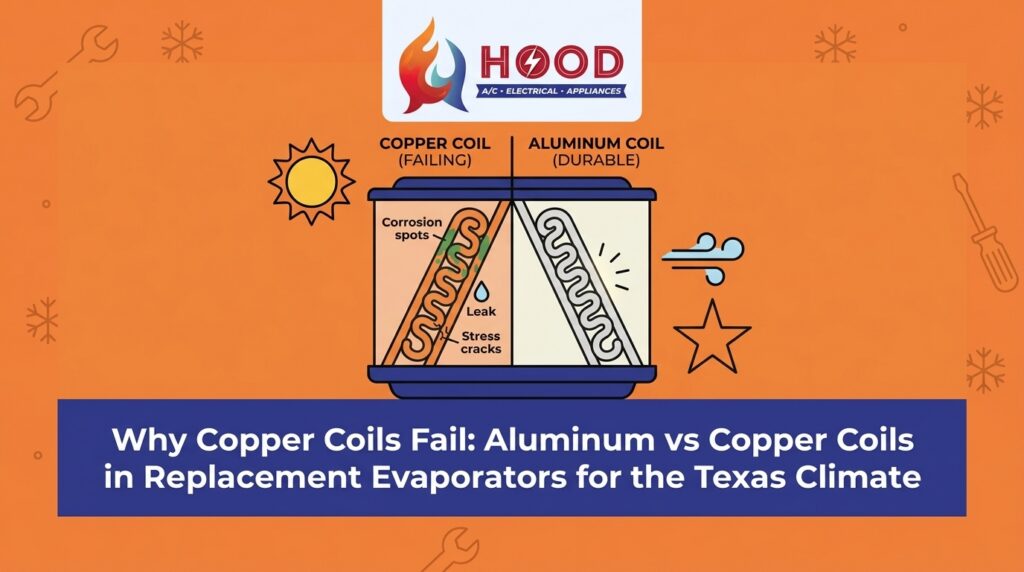
To understand why your system is leaking, we have to look closely at the science of metal degradation. Traditional indoor coils are manufactured using copper tubing. For decades, copper was the undisputed gold standard in the HVAC industry. However, modern tightly sealed homes have introduced a chemical reaction that targets copper specifically: formicary corrosion.
Formicary corrosion, often referred to by our installation crews as “ant’s nest” corrosion, is a complex chemical attack on copper tubing. It is caused by exposure to organic acids, primarily acetic and formic acids. Where do these acids come from? They are byproducts of common Volatile Organic Compounds (VOCs) found right inside your home. Everyday items like household cleaning supplies, cosmetics, hairspray, air fresheners, fresh paint, and even the off-gassing from new building materials or furniture release these invisible compounds into your indoor air.
As your system circulates air throughout the house, it pulls these VOCs directly across the wet indoor coil. Over time, the organic acids eat away at the copper, creating microscopic, tunneling pinholes that look remarkably like an ant’s nest under a microscope. Because these tunnels are subsurface and highly irregular, our field technicians find them virtually impossible to braze, patch, or repair reliably. Once a copper coil develops one formicary leak, dozens more are usually forming right behind it.
In our experience at Hood Service Company serving Corsicana, Texas since 2015, diagnosing these specific microscopic leaks requires specialized equipment and a deep understanding of local environmental factors. We frequently see the aftermath of this chemical wear. Take a recent pre-winter inspection we performed in our area, for example. A local homeowner called us out for a routine fall heating-startup, only for our diagnostic tools to reveal their old copper coil had completely failed after enduring the long summer. We installed a brand new unit on time in an efficient manner, and because we recommended an all-aluminum system, the new unit works great—and is completely immune to the formicary corrosion that destroyed their previous system.
Understanding how these indoor contaminants interact with your equipment is just as critical as understanding the airflow through condenser coils outside your home. Both environments require specific materials and maintenance strategies to survive.

The Texas Climate Catalyst: Humidity Meets Indoor Air Pollutants
The chemical reaction that destroys copper does not happen in a vacuum. It requires a specific catalyst to accelerate the process, and our regional weather provides the perfect storm. The hot, humid Texas summers require high-capacity, prolonged cooling cycles. As your air conditioner runs, it pulls immense amounts of humidity out of the indoor air, resulting in heavy, constant condensation on the evaporator coil.
This moisture is a normal part of the cooling process, but we consistently notice it becomes problematic when mixed with poor indoor air quality. According to the EPA, indoor air pollutant levels can routinely be two to five times higher than outdoor levels. This concentration spikes dramatically as we transition out of summer. When you close up the house, seal the windows, and prepare for the fall heating-startup, you inadvertently trap all those household VOCs inside.
The perfect storm for coil failure we see locally:
- Trapped Contaminants: A tightly sealed home prevents fresh air from diluting indoor VOC concentrations.
- Constant Moisture: High indoor humidity ensures the evaporator coil remains wet for long periods.
- Acidic Condensate: The trapped VOCs dissolve into the condensation on the coil, turning normal water into a mildly acidic bath.
- Accelerated Decay: This acidic moisture sits on the copper tubing, rapidly speeding up the formicary corrosion process compared to homes in dry, arid climates.
This is exactly why our Hood Service Company technicians discover so many leaks during fall inspections. The coil has spent the entire summer soaking in an acidic moisture bath. By the time the weather cools down and we check the system in October, the microscopic pinholes have finally eaten all the way through the copper wall, allowing precious refrigerant to escape.
Copper vs. Aluminum Evaporator Coils: A Direct Comparison
When it is time to replace a leaking evaporator coil, understanding the differences between the two primary materials is vital for the long-term health of your HVAC system. Historically, copper was the only logical choice. Today, our industry has shifted dramatically. Let’s break down exactly how these two materials compare based on what we see in the field.
| Feature | Traditional Copper Coils | Modern Aluminum Coils |
|---|---|---|
| Formicary Corrosion | Highly vulnerable to VOC-induced organic acid attacks. | 100% metallurgically immune to formicary corrosion. |
| Heat Transfer | Historically superior thermal conductivity. | Excellent conductivity; modern designs bridge the historical gap. |
| Durability in Humidity | Prone to rapid degradation when exposed to acidic moisture. | Highly resilient against moisture and organic household acids. |
| Repairability | Can be brazed, but formicary leaks are usually unrepairable. | Difficult to braze in the field; usually requires full replacement if physically punctured. |
| Industry Standard | Phasing out for residential indoor coils in humid regions. | The new standard adopted by major HVAC manufacturers. |
Heat Transfer Efficiency
For many years, contractors preferred copper because it boasts a naturally higher thermal conductivity than aluminum. This means copper transfers heat out of your home’s air slightly faster. However, modern engineering has completely changed the landscape. Manufacturers have redesigned aluminum coils—often using thicker tubing walls, enhanced fin designs, and micro-channel technology—to provide the exact same heat transfer efficiency and SEER ratings as their copper predecessors. We assure our customers that you do not sacrifice any cooling performance or energy efficiency by making the switch to aluminum.
Corrosion Resistance
This is where the comparison heavily favors modern materials. Copper’s fatal flaw in today’s tightly sealed homes is its vulnerability to organic acids. Aluminum, on the other hand, is metallurgically immune to formicary corrosion. The chemical reaction that causes the “ant’s nest” tunneling in copper simply does not occur in aluminum. While aluminum can theoretically suffer from galvanic corrosion if it comes into direct contact with dissimilar metals, modern manufacturing techniques isolate the aluminum components to prevent this. Since we opened our doors in 2015, our installation teams have watched major HVAC manufacturers aggressively abandon copper in favor of all-aluminum indoor coils specifically to solve the VOC pinhole leak problem in our humid environment.
Breaking the Cycle: How Indoor Air Quality Upgrades Protect Your HVAC System
Upgrading to an all-aluminum coil is the definitive mechanical fix for formicary corrosion. However, in our daily work improving indoor air quality across Corsicana, we remind homeowners that a new coil only treats the symptom; it does not eliminate the root cause. The household VOCs, off-gassing chemicals, and organic acids are still trapped inside your home’s air envelope. While your new aluminum coil will not leak, those contaminants are still circulating through your ductwork and into your living spaces.
Protecting your new equipment investment—and the health of your family—requires a proactive approach to the air inside your home. By integrating indoor air quality solutions, you can drastically reduce the concentration of these harmful organic acids.
Steps we recommend to improve your home’s air quality and protect your system:
- Source Control: Be mindful of the chemicals you use indoors. Opt for low-VOC paints, natural cleaning products, and ensure proper ventilation when using strong adhesives or cosmetics.
- Active Ventilation: Because homes in Corsicana, Texas are built tightly for energy efficiency, they trap stale air. Mechanical ventilation systems, like Energy Recovery Ventilators (ERVs), exchange stale, VOC-heavy indoor air with fresh outdoor air without losing your heating or cooling energy.
- Advanced Filtration: Standard 1-inch fiberglass filters do nothing to stop VOCs. Upgrading to deep-pleated media filters or systems with activated carbon can help capture and neutralize chemical off-gassing.
- Air Purification: Whole-home active air purifiers use advanced technologies, such as targeted UV light or catalytic oxidation, to break down complex VOC molecules into harmless water vapor and carbon dioxide before they ever reach your evaporator coil.
By addressing the overall air quality, you ensure that the air passing over your newly installed aluminum coil is clean, healthy, and safe for both your HVAC equipment and your family to breathe.
The Importance of Proactive Pre-Winter Inspections
Because formicary corrosion starts at a microscopic level, you will rarely notice a sudden, catastrophic failure. Instead, our technicians observe that the system slowly loses refrigerant over weeks or months. The air coming from your vents might feel slightly less cold, or your system might run a few minutes longer each cycle to reach the target temperature. By the time you notice a severe drop in performance, the system is already under immense strain, risking damage to the expensive outdoor compressor.
This is why catching these leaks early is so critical. A comprehensive fall heating-startup check by a licensed professional is your best defense against unexpected winter breakdowns. When our team evaluates your system before the heavy heating season begins, we are looking for the subtle signs of component fatigue that homeowners naturally miss.
What our thorough pre-winter inspections uncover:
- Refrigerant Levels: Checking the exact operating pressures and temperatures to ensure the system hasn’t slowly leaked refrigerant over the summer.
- Coil Integrity: Visually inspecting the evaporator coil for oil residue, which is a telltale sign that refrigerant is escaping through microscopic pinholes.
- Drainage Systems: Ensuring the condensate drain lines are clear of the algae and sludge buildup that occurs during heavy summer usage.
- Airflow Restrictions: Measuring static pressure to confirm that a dirty coil or clogged filter isn’t suffocating the system before it switches over to heating mode.
Proactive discovery is always better than an emergency failure. Finding a leaking copper coil during a routine check allows you to plan a thoughtful, scheduled upgrade to an all-aluminum coil. Waiting until the system completely fails on a freezing winter night limits your options and adds unnecessary stress. Staying on top of routine AC maintenance ensures your system’s integrity is verified before the weather turns.
Making the Right Choice for Your Home’s Long-Term Comfort
Dealing with a leaking evaporator coil is never pleasant, but understanding the science behind the failure empowers you to make a permanent fix. Traditional copper coils simply cannot withstand the combination of high humidity and trapped household VOCs that define our modern indoor environments. All-aluminum coils have proven to be the definitive, long-term solution against formicary corrosion.
Since 2015, our crew at Hood Service Company has helped countless Corsicana homeowners navigate this exact transition, ensuring their replacement equipment is engineered to survive the unique demands of our regional climate. An expert local assessment of your current system will determine the most efficient and reliable path forward for your home.
If you suspect your system is losing performance, or if a recent inspection revealed a compromised copper coil, do not wait for a complete breakdown. Reach out to discuss your options for a durable, all-aluminum AC replacement and secure your home’s comfort for years to come.
Frequently Asked Questions
Why do copper evaporator coils leak?
Copper evaporator coils leak primarily due to formicary corrosion, a chemical reaction caused by volatile organic compounds (VOCs) in your home’s air. These VOCs mix with condensation on the coil to form organic acids that eat microscopic, tunneling pinholes through the copper tubing. Because the pinholes are so small and numerous, the coil slowly loses refrigerant and cannot be reliably patched.
What is formicary corrosion in HVAC?
Formicary corrosion, often called “ant’s nest” corrosion, is a specific type of metal degradation that affects copper tubing in HVAC systems. It occurs when organic acids from everyday household products attack the copper, creating tiny, irregular subsurface tunnels. This reaction is heavily accelerated by the constant moisture present on an active evaporator coil.
Are aluminum coils better for indoor air quality?
Aluminum coils themselves do not actively clean your indoor air, but they are completely immune to the chemical damage caused by poor indoor air quality. While traditional copper degrades when exposed to household VOCs, an aluminum coil will remain structurally sound. However, you still need dedicated ventilation or purification systems to actually remove the VOCs from the air you breathe.
Why are AC manufacturers switching to aluminum coils?
Manufacturers are switching to all-aluminum coils because modern homes are sealed much tighter than in the past, trapping corrosive VOCs indoors. Because aluminum is metallurgically immune to the formicary corrosion that destroys copper, it drastically reduces warranty claims and premature coil failures. The industry has adopted aluminum as the new standard for reliability in humid environments.
How do household VOCs damage my air conditioner?
Household VOCs from cleaning supplies, paints, cosmetics, and building materials release invisible gases into your home’s airstream. When your air conditioner runs, it pulls these gases across the wet indoor coil. The gases dissolve into the condensation, creating a mildly acidic bath that slowly eats away at traditional copper components until they rupture.
How long do aluminum evaporator coils last in humid climates?
When properly maintained, an all-aluminum evaporator coil can easily last 12 to 15 years, matching the expected lifespan of the entire HVAC system. Because aluminum does not suffer from VOC-induced formicary corrosion, it is highly resilient in humid climates where constant condensation is a daily reality. Regular maintenance, such as keeping the coil clean and changing air filters, ensures maximum longevity.